



Your test suite passes. Coverage looks solid. Then production users report that your recommendation engine quietly excludes an entire demographic, or your fraud-detection model flags legitimate transactions at three times the expected rate for certain regions. Traditional testing never caught it because traditional testing was never designed for systems that learn from data. AI testing bridges that gap—and if your team is not doing it yet, you are shipping risk you cannot see.
This article gives you a concrete, practitioner-focused playbook. You will learn what AI testing actually involves, how to structure validation and bias-detection workflows, which fairness metrics to track, and where most QA teams stumble. Everything here is written for testers, SDETs, and test leads who need to own quality for ML-powered features inside a Scrum cadence.
What Is AI Testing?
AI testing is the practice of verifying and validating systems whose behavior is shaped by learned patterns rather than deterministic code. Where a conventional function returns the same output for the same input, a trained model's predictions depend on its training data, feature engineering, hyperparameters, and the statistical distributions it has encoded. Your job as a QA professional is to make sure those predictions are correct, fair, explainable, and stable under real-world conditions.
The ISO/IEC 25010 product-quality model defines characteristics such as functional suitability, reliability, and security that apply to any software product [1]. For AI systems, you extend those characteristics with concerns unique to probabilistic outputs: data quality assessment before training, AI model validation after training, bias detection across protected attributes, and ML system robustness under adversarial or shifting inputs.
Why It Matters for QA
Most organizations treat model development as a data-science concern and hand QA only the API wrapper. That leaves enormous risk surface uncovered. A model can satisfy every API contract test you write and still produce outputs that are discriminatory, brittle, or opaque to the humans who depend on them.
The ISTQB Foundation Level syllabus defines testing as a means to reduce the level of risk of a software product [2]. AI testing extends that principle to probabilistic systems where "correct" is not a binary state but a distribution of acceptable outcomes. If your team does not explicitly plan for this, defects will surface in production—where they are orders of magnitude more expensive to fix.
Core Disciplines of AI Testing
AI testing is not a single activity. It covers several interconnected disciplines. Here is how each one maps to your QA responsibilities.
Data Quality Assessment
Your model is only as reliable as the data it learns from. Data quality assessment means verifying completeness, consistency, accuracy, and representativeness of training, validation, and test datasets before any model sees them.
What you check:
- Completeness: Are there missing values? What percentage of records is null for critical features?
- Distribution alignment: Does the training set reflect the population the model will serve in production?
- Label accuracy: For supervised models, are labels correct and consistently applied?
- Leakage: Does the training set contain information that would not be available at inference time?
A quick sanity check: if your training data over-represents one customer segment by 3×, your model will likely over-optimize for that segment. Catch it here, not in a bias audit later.
AI Model Validation
AI model validation confirms that a trained model meets defined performance thresholds on unseen data. You validate accuracy, precision, recall, F1 score, and domain-specific metrics—then verify that performance holds across meaningful slices (geography, age group, device type).
Slice-based validation is critical. A model with 94% overall accuracy might drop to 72% for a minority subgroup. Without slicing, you will never see it.
Bias Detection and Fairness Metrics
Bias detection answers the question: does this model treat different groups equitably? You need quantifiable fairness metrics, not subjective assessments.
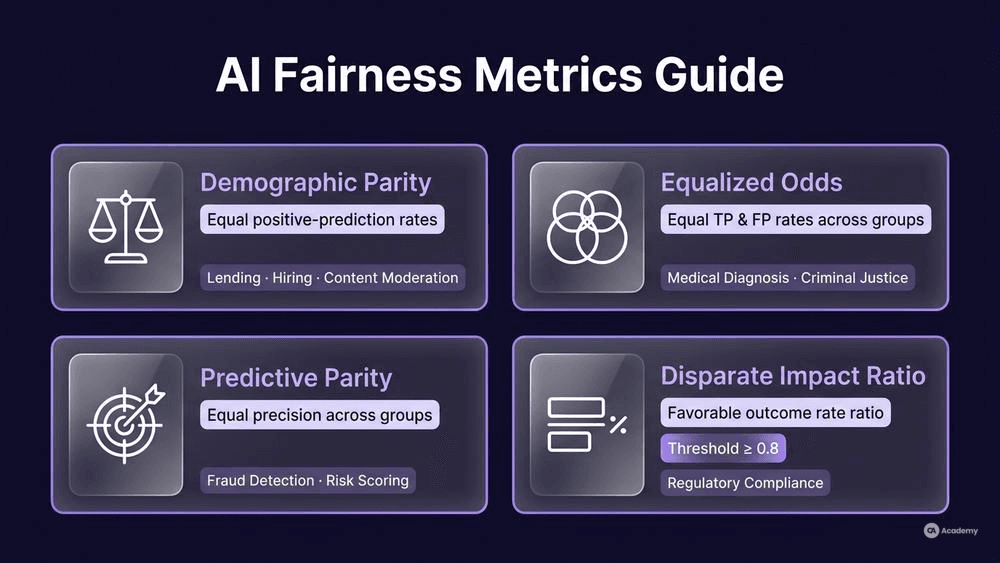
Key fairness metrics to track:
Metric | What It Measures | When to Use |
|---|---|---|
Demographic parity | Equal positive-prediction rates across groups | Lending, hiring, content moderation |
Equalized odds | Equal true-positive and false-positive rates across groups | Criminal justice, medical diagnosis |
Predictive parity | Equal precision across groups | Risk scoring, fraud detection |
Disparate impact ratio | Ratio of favorable outcome rates (threshold commonly ≥ 0.8) | Regulatory compliance screening |
Choose fairness metrics that align with the risk context of your application. No single metric works universally—what matters is that you define, measure, and monitor them explicitly.
Explainable AI Verification
If your stakeholders—or regulators—cannot understand why the model made a decision, you have an explainability gap. Explainable AI verification ensures that model outputs can be traced to interpretable feature contributions.
Practical techniques include SHAP (SHapley Additive exPlanations) values for feature-importance attribution and LIME (Local Interpretable Model-agnostic Explanations) for instance-level explanations. Your test cases should verify that:
- Feature importance rankings are stable across similar inputs.
- Explanations do not contradict domain knowledge (e.g., a medical model should not rank "patient ID" as a top predictor).
- Explanation outputs remain consistent across model retraining cycles.
ML System Robustness
ML system robustness testing evaluates whether model performance degrades gracefully under adversarial inputs, data drift, or edge cases. Think of it as the AI equivalent of stress testing and boundary-value analysis.
What to test:
- Adversarial inputs: Slightly perturbed inputs designed to fool the model (e.g., a single changed pixel flipping an image classification).
- Data drift: Does performance degrade when production data distributions shift from training distributions?
- Out-of-distribution inputs: How does the model handle inputs unlike anything in its training set?
The ISO/IEC/IEEE 29119-4 standard describes techniques for test case design that can be adapted for robustness testing of AI components [3].
How to Build an AI Testing Workflow
Here is a step-by-step workflow your team can implement within a Scrum cadence. Each step maps to a sprint activity.
Prerequisites and Setup
Before you write a single AI test case, establish:
- Quality criteria for the model: What accuracy threshold must it meet? What fairness metrics apply? What latency constraints exist?
- Test data strategy: Curate separate datasets for validation and testing. Never test on training data.
- Monitoring baseline: Record current model performance metrics so you can detect regression.
Step 1 — Validate Data Before Training
Run automated data-quality checks before every training pipeline execution. Check for nulls, outliers, schema drift, and representation imbalance. Fail the pipeline if data quality falls below your team's agreed threshold.
Step 2 — Validate Model Performance
After training, evaluate on held-out test data. Compute overall metrics and slice-based metrics. Compare against baselines and previous model versions.
`python
Minimal slice-based validation example
from sklearn.metrics import classification_report
for groupname, groupdata in testdata.groupby("demographic"): ytrue = groupdata["label"] ypred = model.predict(groupdata[features]) print(f"--- {groupname} ---") print(classificationreport(ytrue, y_pred)) `
Step 3 — Run Bias Detection
Compute your selected fairness metrics across protected attributes. Compare disparate impact ratios and equalized-odds differences. Flag any metric that breaches your agreed threshold for review.
Step 4 — Verify Explainability
Generate SHAP or LIME explanations for a sample of predictions. Verify feature-importance rankings against domain expectations. Confirm that explanation outputs are stable across repeated runs.
Step 5 — Stress-Test for Robustness
Inject adversarial perturbations, out-of-distribution samples, and simulated data drift. Measure performance degradation. Define a "graceful degradation" threshold: the model should fall back to a safe default rather than producing confident but wrong predictions.
Step 6 — Integrate into CI/CD
Add AI-specific quality gates to your pipeline. A gate should fail the build if any release-blocking validation, bias, or robustness check fails. Remaining issues are triaged and accepted by the release owner based on risk.
Common Pitfalls
- Testing only on aggregated metrics. Aggregated accuracy hides subgroup failures. Always slice.
- Using training data as test data. This inflates every metric and tells you nothing about generalization.
- Treating bias detection as a one-time activity. Data distributions shift; rerun bias checks on every retrain and on a regular production cadence.
- Ignoring explainability until a regulator asks. By then, remediation is expensive and time-pressured.
Best Practices for Sustainable AI Quality
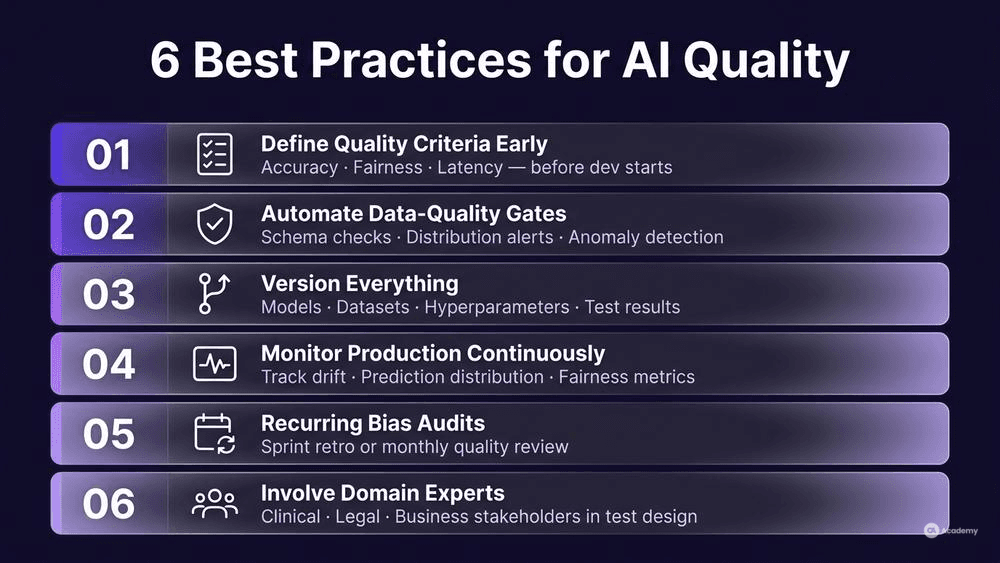
- Define quality criteria before development starts. Align with product owners on acceptable accuracy ranges, fairness thresholds, and latency budgets during backlog refinement—not after the model is trained.
- Automate data-quality gates. Manual data review does not scale. Use schema validators, distribution checks, and anomaly detectors in your data pipeline.
- Version everything. Track model versions, dataset versions, hyperparameters, and test results together. You should be able to reproduce any historical prediction.
- Monitor production continuously. AI testing does not end at deployment. Track prediction distributions, feature drift, and fairness metrics in production. Set alerts for drift beyond your baseline.
- Make bias audits a recurring ceremony. Add bias-detection review to your sprint retrospective or a dedicated monthly quality review. Treat fairness metrics with the same rigor as performance metrics.
- Involve domain experts in test design. Testers define the how; domain experts define the what. A healthcare model's test cases should be reviewed by clinical stakeholders, not just engineers.
The ISO/IEC/IEEE 29119-2 standard's test process framework provides a structure for planning, designing, and executing tests that can be adapted to incorporate AI-specific validation steps [4].
What Not to Do
Knowing what to avoid is as valuable as knowing what to do. Here are the most damaging mistakes QA teams make with AI testing.
Anti-Pattern | Why It Hurts | What to Do Instead |
|---|---|---|
Relying solely on unit tests for model code | Unit tests verify code logic, not learned behavior. A model can pass every unit test and still produce biased outputs. | Combine unit tests with model-level validation, bias audits, and robustness checks. |
Copying fairness thresholds from another domain | A threshold appropriate for lending may be inappropriate for content moderation. Context matters. | Define fairness criteria specific to your application's risk profile and regulatory environment. |
Skipping explainability for "simple" models | Even logistic regression can produce counterintuitive feature weights on messy data. | Verify explainability for every model, regardless of perceived complexity. |
Treating AI testing as a data-science responsibility only | Data scientists optimize for model performance. QA ensures the system works for users. These are different objectives. | Embed QA into the ML pipeline from data preparation through production monitoring. |
Assuming stable performance post-deployment | Production data drifts. User behavior changes. Models degrade silently. | Implement continuous monitoring and automated retraining triggers. |
Tools Comparison
Tool | Primary Use | Strengths | Limitations |
|---|---|---|---|
Fairlearn (Microsoft) | Bias detection, fairness metrics | Rich fairness metric library, integrates with scikit-learn | Python-only, requires ML familiarity |
AI Fairness 360 (IBM) | Bias detection, mitigation | Comprehensive metric set, includes mitigation algorithms | Steeper learning curve, heavy dependency footprint |
SHAP | Explainability | Model-agnostic, strong theoretical foundation | Can be slow on large datasets |
Great Expectations | Data quality assessment | Declarative data validation, pipeline integration | Focused on data, not model behavior |
Evidently AI | ML monitoring, drift detection | Production monitoring dashboards, open-source core | Enterprise features require paid tier |
Giskard | ML system robustness, vulnerability scanning | Automated adversarial testing, LLM support | Newer project, smaller community |
Choose tools based on your stack and risk profile. Many teams combine Great Expectations for data quality, Fairlearn or AI Fairness 360 for bias detection with fairness metrics, SHAP for explainability, and Evidently for production monitoring.
Real-World Example: AI Testing for a Loan-Approval Model
⚠️ Disclaimer: The following scenario is an illustrative example based on typical industry patterns. The specific metrics are hypothetical estimates designed to demonstrate realistic outcomes, not measured data from a documented project. They should not be cited as factual benchmarks.
Context
A mid-size financial services company deploys a machine-learning model to pre-screen loan applications. The model processes applicant financial data and outputs an approval recommendation. The QA team is asked to validate the model before production launch.
Challenge
Initial model validation shows 91% overall accuracy, which meets the product team's threshold. However, the QA team has no process for evaluating fairness across protected demographic groups, no explainability verification, and no robustness testing for edge cases such as applicants with thin credit histories.
Solution
The QA team implements a structured AI testing workflow:
- Data quality assessment: Audit training data for representativeness. Discovery: one demographic group represents 8% of training data but 22% of the expected applicant pool. The team flags this imbalance and works with data engineering to rebalance the dataset.
- Slice-based model validation: Evaluate accuracy, precision, and recall for each demographic group separately—not just in aggregate.
- Bias detection with fairness metrics: Compute disparate impact ratio and equalized odds across protected groups. Initial results show a disparate impact ratio of 0.71 for one group (below the commonly used 0.8 threshold).
- Explainability verification: Generate SHAP explanations for a sample of predictions. Identify that zip code is the third-most-important feature—a proxy variable that correlates with demographic attributes.
- Robustness testing: Test model behavior on applicants with incomplete financial histories and edge-case income values.
Results (Illustrative)
- Slice-based accuracy variance across groups reduced from 19 percentage points to 6 after data rebalancing and feature review.
- Disparate impact ratio improved from 0.71 to 0.84 after removing the proxy variable and retraining.
- Three robustness edge cases identified and documented, leading to fallback logic for thin-file applicants.
- Overall model accuracy remained at 89%—a small decrease from 91%, but now with equitable performance across groups.
Key Takeaways
- Aggregate accuracy masked a significant fairness gap that slice-based validation exposed.
- Proxy variables (like zip code) introduce bias indirectly. Explainability tools help surface them.
- Accepting a small accuracy trade-off for improved fairness is a product decision, not a QA decision—but QA must surface the data that makes that decision informed.