



Every team ships bugs. That is a given. But the difference between a team that ships known, triaged bugs and one that gets blindsided by production incidents often comes down to one role: the quality analyst. If you have ever watched a critical defect sail through three sprint reviews undetected, you already know the cost of skipping structured quality assurance. This article breaks down what a quality analyst does, how the role fits inside a modern Scrum team, and what you can start doing differently tomorrow. Whether you are stepping into the role or rethinking how your team handles requirement validation and defect tracking, you will walk away with concrete workflows and checklists.
What Is a Quality Analyst?
A quality analyst (QA analyst) is the person responsible for verifying that software meets its stated requirements and the implicit expectations users bring to it. The ISTQB Foundation Level syllabus defines testing as "the process consisting of all lifecycle activities, both static and dynamic, concerned with planning, preparation and evaluation of a component or system and related work products" [1]. A quality analyst turns that definition into daily practice.
Why the Role Matters for QA
Think of a quality analyst as the team's structured skeptic. Developers optimise for building; product owners optimise for scope. The quality analyst optimises for confidence — confidence that a feature works, that edge cases have been considered, and that the team can articulate exactly how much risk remains at release time.
Without that structured skepticism, teams tend to rely on informal "looks good to me" checks. This often leads to defect clusters that surface late — when fixes cost the most and trust erodes the fastest.
Critical thinking prompt: Consider your current sprint workflow. At which ceremony does a quality analyst have the greatest leverage — refinement, planning, or review? Why might moving QA involvement earlier change your defect distribution?
Core QA Analyst Responsibilities
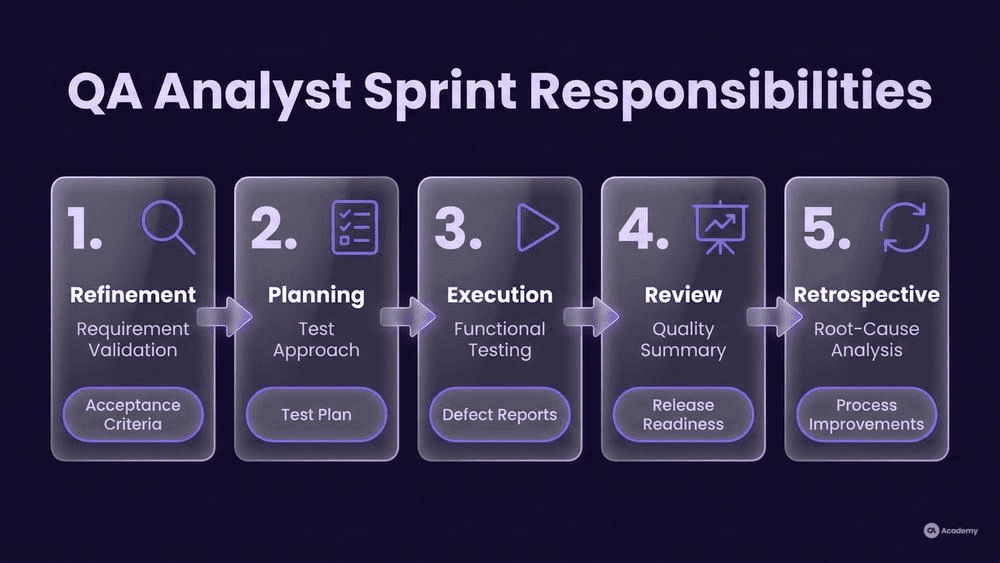
QA analyst responsibilities span more than clicking through screens. Here is a practical breakdown organised by sprint phase:
Sprint Phase | Key QA Analyst Responsibility | Primary Output |
|---|---|---|
Refinement | Requirement validation, testability review | Clarified acceptance criteria |
Planning | Test approach, risk identification | Lightweight test plan |
Execution | Functional testing, exploratory testing | Test results, defect reports |
Review | Demo support, quality summary | Release readiness assessment |
Retrospective | Defect root-cause analysis | Process improvement actions |
Notice that testing execution is only one row. The quality analyst's impact comes as much from upstream validation as from downstream verification.
Requirement Validation — the First Line of Defense
Requirement validation is where the quality analyst prevents defects rather than finding them. The goal is straightforward: make sure the team builds the right thing before investing sprint capacity in building it correctly.
The "What If" Framework
When reviewing a user story, apply this lightweight framework:
- What if the input is empty? — Identify null, blank, and missing-data scenarios.
- What if the input is extreme? — Boundary values, maximum lengths, negative numbers.
- What if the user skips a step? — Out-of-sequence navigation, back-button behaviour.
- What if a dependency fails? — API timeout, third-party service outage, database lock.
- What if the user has no permission? — Role-based access, feature flags, licence tiers.
Each "What If" question should produce at least one concrete acceptance criterion. If a product owner cannot answer the question, the story is not ready for sprint planning.
What Not to Do in Requirement Validation
- Do not treat acceptance criteria as test cases. Acceptance criteria describe what the system should do; test cases describe how you verify it — including negative paths the criteria may not mention.
- Do not wait until sprint planning to raise ambiguities. Flag them during refinement. By planning, the window for clarification has already narrowed.
- Do not assume silence means "no constraint." If a story says nothing about performance, that does not mean performance is irrelevant — it means nobody has defined the threshold yet.
Design challenge: Take a user story from your current backlog. Apply the five "What If" questions and draft three acceptance criteria that are not already documented. How many of those criteria would have surfaced naturally without the framework?
Functional Testing Role in Practice
The functional testing role is the most visible part of the quality analyst's work. ISO/IEC 25010 defines a product quality model that includes functional suitability — comprising functional completeness, functional correctness, and functional appropriateness [2]. These sub-characteristics give you a precise lens for evaluating whether software does what it should.
Structuring Your Functional Testing
Rather than writing test cases in isolation, anchor each case to one of these three sub-characteristics:
- Functional completeness: Does the feature cover all specified tasks and user objectives?
- Functional correctness: Does the feature produce the right results with the needed degree of precision?
- Functional appropriateness: Does the feature facilitate the user's task in a way that fits their workflow?
A test that confirms a calculation is correct (correctness) is valuable. A test that also verifies the result is displayed where the user expects it (appropriateness) is more valuable.
What Not to Do in Functional Testing
- Do not limit testing to the happy path. If your test suite only covers "user enters valid data and sees success message," you are testing the demo, not the product.
- Do not skip exploratory testing because you have automated regression. Automation confirms that known scenarios still pass. Exploratory testing finds unknown scenarios worth automating next.
- Do not conflate "test passed" with "feature works." A test passes against its assertions. Whether those assertions fully represent user expectations is a separate, and harder, question.
Defect Tracking Tasks That Actually Move the Needle
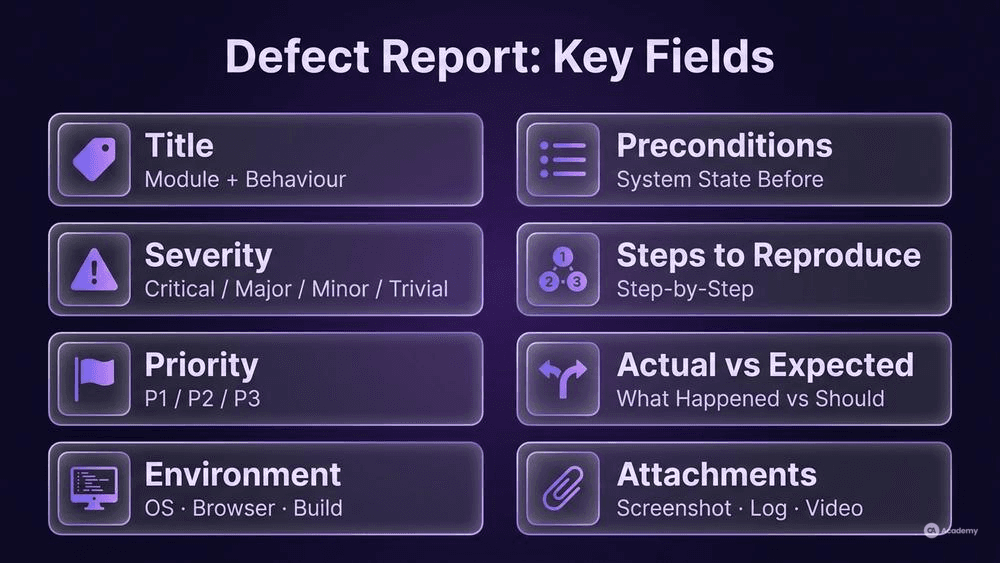
Defect tracking is more than logging bugs in Jira. Effective defect tracking tasks give the team a shared language for prioritising fixes and a data trail for identifying recurring problem patterns.
Structured Defect Report Template
Use this template as a starting point and adapt it to your team's context:
` Severity: Critical / Major / Minor / Trivial Priority: P1 (fix now) / P2 (fix this sprint) / P3 (backlog) Environment: [OS, browser, build version, test data set] Preconditions: [State of the system before reproduction] Steps: 1. 2. 3. Actual Result: [What happened] Expected Result: [What should have happened, citing requirement/AC] Attachments: [Screenshot, video, logs] Root Cause Hint: [Optional — if you have a hypothesis, share it] `
What Not to Do in Defect Reporting
- Do not use vague titles. "Login broken" helps nobody. "Login — OAuth redirect returns 403 when user has MFA enabled on staging" helps everybody.
- Do not skip the expected result. Without it, the developer has to guess your intent, and the triage meeting wastes time re-establishing context.
- Do not hoard defects. If you find a critical issue, raise it immediately — do not wait until the end of the test cycle. Defect age correlates directly with fix cost.
Best Practices for Software Quality Assurance
These practices apply regardless of tooling or framework. They are drawn from industry standards and field experience.
- Shift testing left — but also shift it right. Static analysis, peer reviews, and requirement validation belong early. Production monitoring, canary releases, and observability belong late. Both matter.
- Define "done" with testability in mind. Your Definition of Done should include testing activities such as test execution, defect resolution criteria, and coverage thresholds agreed upon by the team [1].
- Use risk-based test prioritisation. Not every feature carries equal risk. Allocate your deepest coverage to the areas with the highest business impact and the greatest technical uncertainty.
- Make quality visible. Share test metrics in sprint reviews — not to gatekeep, but to inform. Defect trend charts, requirement coverage maps, and risk heatmaps give stakeholders the information they need to make informed release decisions.
- Automate the repeatable; explore the unpredictable. Regression suites should run automatically. Your human attention is better spent on exploratory sessions where domain knowledge and curiosity find what scripts cannot.
The TMMi model outlines maturity levels for test processes, progressing from initial (ad hoc) through managed, defined, measured, and optimisation stages [3]. Evaluate honestly where your team sits — and focus improvement efforts on the next level, not on the aspirational end state.
Tools Comparison
No single tool covers every QA analyst responsibility. Here is a comparison organised by task category:
Category | Tool | Best Suited For | Key Consideration |
|---|---|---|---|
Test Management | Zephyr Scale | Jira-integrated teams | Native Jira integration reduces context switching |
Test Management | TestRail | Cross-platform test planning | Strong reporting, but separate from issue tracker |
Defect Tracking | Jira | Scrum/Kanban teams | Highly configurable; can become over-configured |
Defect Tracking | Azure DevOps | Microsoft-ecosystem teams | Tight CI/CD integration |
Functional Testing | Selenium | Browser-based UI testing | Broad language support; steeper learning curve |
Functional Testing | Cypress | Modern web applications | Fast execution; JavaScript-only |
API Testing | Postman | REST API validation | Intuitive UI; collaboration features |
Exploratory Testing | Rapid7 InsightConnect / Session-based notes | Session-based exploratory testing | Structured note-taking improves reproducibility |
Evaluation exercise: Map your current toolchain against this table. Identify one category where you are using a workaround (spreadsheets, Slack messages, memory) instead of a dedicated tool. What would change if you formalised that category?
Real-world Example / Case Study
⚠️ Disclaimer: The following scenario is an illustrative example based on typical industry patterns. The specific metrics are hypothetical estimates designed to demonstrate realistic outcomes, not measured data from a documented project. They should not be cited as factual benchmarks.
Context
A mid-size fintech company with four Scrum teams and approximately 30 developers was releasing a consumer-facing payments application every two weeks. The teams had automated unit tests and a basic CI pipeline, but had limited formal QA analyst involvement.
Challenge
Defects reported by end users after releases were consistently high. Post-incident reviews revealed that roughly 40% of all logged defects traced back to requirement misunderstandings — features that were built correctly according to the developer's interpretation, but did not match the product owner's intent. There was minimal or informal requirement validation, and functional testing was performed ad hoc by developers before merging pull requests.
Solution
The company introduced a dedicated quality analyst into each Scrum team with a defined remit:
- Requirement validation at refinement — using the "What If" framework outlined earlier to surface ambiguities before sprint commitment.
- Structured defect reporting — adopting the template from this article to standardise communication between QA analysts and developers.
- Risk-based functional testing — prioritising test effort on high-impact payment flows rather than attempting uniform coverage.
- Quality metrics in sprint review — presenting defect trend data and requirement coverage gaps to stakeholders each sprint.
Results (Illustrative)
After three quarters of operation under this model, the teams observed the following illustrative improvements:
- Requirement-related defects dropped by approximately 65%.
- Post-release critical defects decreased to near-zero per cycle (down from an average of three to four per release).
- Average defect resolution time decreased by roughly 50%, attributed to clearer defect reports and earlier detection.
- Sprint velocity stabilised — initial velocity dipped as teams adjusted to the additional ceremony time, but recovered and marginally improved as rework decreased.
Key Takeaways
- The largest single improvement came from upstream validation, not from more testing.
- Structured defect reports reduced developer-QA back-and-forth by making reproduction straightforward.
- Making quality data visible in reviews shifted the team's relationship with quality from reactive to proactive.
- The initial velocity dip is normal and expected — teams should plan for a transition period rather than expecting immediate throughput gains.
Career Path and Certification
Where Quality Analyst Careers Lead
Quality assurance careers typically follow one of three trajectories:
Path | Progression | Key Skills to Develop |
|---|---|---|
Technical QA | QA Analyst → SDET → Test Architect | Programming, framework design, CI/CD |
Management | QA Analyst → QA Lead → QA Manager → Head of Quality | People management, strategy, budgeting |
Specialist | QA Analyst → Performance Tester / Security Tester / Accessibility Specialist | Domain-specific tooling, standards knowledge |
Certifications Worth Considering
- ISTQB Certified Tester Foundation Level (CTFL) v4.0 — The globally recognised baseline certification for software testers [1]. It validates understanding of testing fundamentals, techniques, and management.
- ISTQB Advanced Level Test Analyst — Targets experienced testers who design and execute test cases at a more sophisticated level [4].
- ISTQB Foundation Level Agile Tester — Covers testing practices in agile contexts, relevant if your teams work in Scrum or Kanban [5].
What Not to Do in Career Development
- Do not collect certifications without applying the knowledge. A certification demonstrates potential; consistent practice demonstrates capability. Employers value demonstrated competence over credential accumulation.
- Do not stay exclusively manual. Even if your primary role is manual functional testing, understanding automation concepts, reading test scripts, and contributing to automation strategy makes you significantly more effective — and more employable.
- Do not ignore domain knowledge. A quality analyst who understands fintech regulations, healthcare compliance requirements, or e-commerce conversion funnels brings context that generic testing skills alone cannot provide.