



You shipped a release last sprint with zero critical defects. This sprint, a regression slipped through, a test environment was misconfigured for two days, and nobody caught an outdated test case until a customer filed a bug. What changed? Probably nothing in your team's skill set. What was missing was a systematic way to verify that your testing process itself stays healthy over time. That is exactly what an assurance plan does. It shifts your attention from "are we testing?" to "are we testing well, consistently, and in the right places?" This article walks you through building one that your team will actually use—not a document that collects dust in Confluence.
What Is an Assurance Plan?
An assurance plan is a documented agreement that defines how your team will monitor, evaluate, and improve its own testing processes throughout the project lifecycle. Think of it as a health check protocol for your QA operation itself—not the product under test, but the way you test it.
Where a test plan answers "what are we testing and how?", an assurance plan answers a different question: "how do we know our testing process is working as intended, and what do we do when it drifts?" ISO/IEC/IEEE 29119-3 provides a standardized framework for test documentation that can serve as a foundation for your assurance artifacts [1].
Why It Matters for QA
Without an assurance plan, process problems tend to surface only after something goes wrong in production. You end up firefighting instead of preventing. An assurance plan gives you three things:
- Visibility into whether your testing processes are being followed consistently across sprints, teams, and environments.
- Early warning signals when process adherence degrades—before defects escape.
- Accountability through scheduled compliance verification checkpoints tied to your delivery cadence.
The TMMi framework emphasizes that process assurance activities are a key differentiator between ad-hoc testing organizations and mature ones [2]. But maturity does not mean bureaucracy. The goal is a lean, living document—not a compliance artifact.
Why Your QA Team Needs One
Consider this scenario: your team runs regression tests every sprint, but nobody has reviewed whether the regression suite still covers the critical user journeys after three months of feature changes. Or your test data management process works perfectly when one tester sets it up, but falls apart when that person is on vacation.
These are process gaps, not skill gaps. An assurance plan catches them early by establishing:
- Process adherence checks at predictable intervals
- Compliance verification against your own standards and any regulatory requirements
- Feedback loops that turn audit findings into concrete improvements
Here is a question worth reflecting on: when was the last time your team evaluated whether its own testing practices still match the risks of the current product state?
If you cannot answer that confidently, you likely need an assurance plan.
Comparing Approaches: Lightweight vs. Heavyweight Assurance
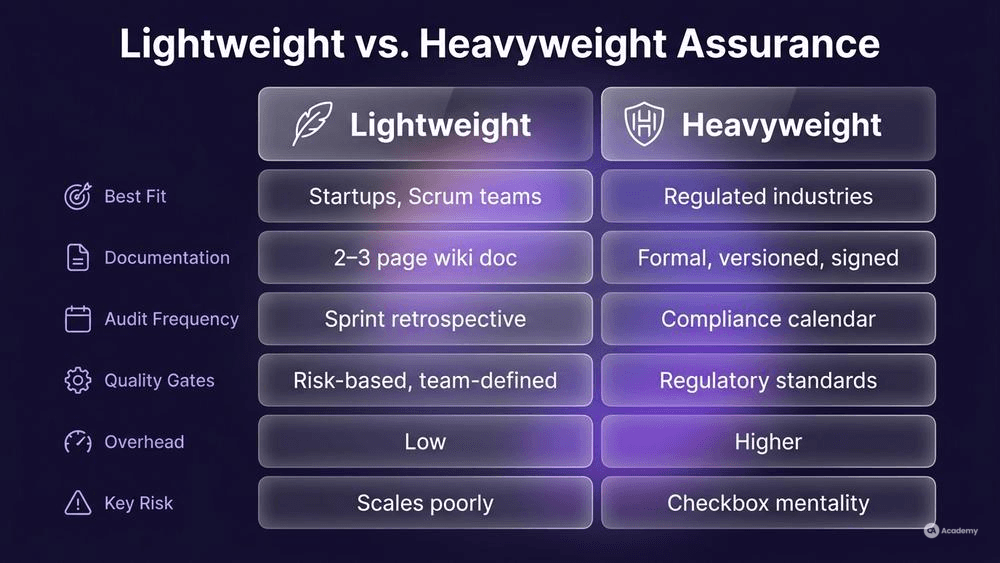
Not every team needs the same level of assurance rigor. The right approach depends on your domain, team size, regulatory context, and organizational maturity. Here is a critical comparison of two common approaches—neither is universally superior, and most teams end up somewhere in between.
Dimension | Lightweight Assurance | Heavyweight Assurance |
|---|---|---|
Best fit | Startups, small Scrum teams, low-regulation domains | Regulated industries (healthcare, finance, automotive) |
Documentation | 2–3 page living document, wiki-based | Formal document with version control, sign-off gates |
Audit frequency | Sprint-aligned retrospective checks | Scheduled external + internal audits per compliance calendar |
Quality gate criteria | Team-defined, risk-based pass/fail | Tied to regulatory standards (e.g., Automotive SPICE [3]) |
Overhead | Low—integrated into existing ceremonies | Higher—requires dedicated process assurance roles |
Risk of under-assurance | Gaps in coverage may go unnoticed longer | Lower, but can miss emerging risks outside the checklist |
Risk of over-assurance | Minimal | Teams may game metrics or treat audits as checkbox exercises |
The critical evaluation: Lightweight plans often succeed in early-stage products because they stay close to the team and evolve fast. However, they can become dangerously informal as teams scale—what worked for 5 testers rarely works for 25 without adaptation. Heavyweight plans provide rigor, but their biggest failure mode is disconnection from daily work. When the assurance plan lives in a separate governance silo, the people doing the actual testing may never read it.
Ask yourself: does your current assurance approach match the actual risk profile of your product, or does it match the risk profile your product had six months ago?
How to Build an Assurance Plan Step by Step
Prerequisites and Setup
Before writing anything, gather these inputs:
- Your current test strategy or test plan — the assurance plan monitors adherence to whatever standards you have already set.
- A list of your quality risks — not product risks, but process risks. What could go wrong with how you test? (e.g., environment instability, coverage gaps, skills gaps, tool misconfiguration)
- Your delivery cadence — sprint length, release frequency, and existing ceremonies.
- Regulatory or contractual requirements — if any external standards apply (ISO, HIPAA, PCI-DSS, Automotive SPICE [3]).
Step 1: Define Your Assurance Scope
Decide what processes your assurance plan will cover. Typical scope includes:
- Test planning and estimation
- Test design and review
- Test environment management
- Defect management workflow
- Test data management
- Automation suite maintenance
- Regression coverage adequacy
Do not try to cover everything at once. Start with the two or three areas where process breakdowns have caused the most pain in recent sprints, then expand.
Step 2: Establish Quality Gate Criteria
Quality gate criteria are the conditions that must be met before a process step is considered complete. The key principle: define gates by risk, not by arbitrary thresholds.
Effective quality gate criteria follow this pattern:
- Pipeline fails if any release-blocking or critical-severity test fails.
- Pipeline fails if a mandatory test suite does not complete execution (e.g., due to environment failure).
- Pipeline pauses if the team's own agreed risk threshold is crossed—this threshold is set collaboratively and revisited regularly, not fixed permanently.
- Remaining failures are triaged by severity and accepted (or deferred) by the release owner with documented justification.
This risk-based approach avoids the trap of fixed pass-rate percentages, which teams often game or which become meaningless as suite composition changes.
ISO/IEC/IEEE 29119-2 provides a process model that describes organizational, management, and dynamic test processes, which can inform how you structure quality gates within your workflow [4].
Step 3: Define Your Compliance Verification Activities
These are the specific checks you will run to verify process adherence. Be concrete:
Activity | What It Checks | Frequency | Owner |
|---|---|---|---|
Test case review sampling | Are test cases traceable to requirements and well-structured? | Every sprint | Test Lead |
Automation code review | Do automated tests follow coding standards and remain maintainable? | Bi-weekly | SDET Lead |
Environment health check | Are test environments configured correctly and matching production parity? | Weekly | DevOps/QA |
Defect workflow audit | Are defects logged, triaged, and resolved per defined SLA? | Monthly | QA Manager |
Coverage gap analysis | Does the regression suite still cover critical user paths? | Quarterly | Test Lead |
Step 4: Write It Down (Briefly)
Your assurance plan document should fit in 2–4 pages and contain:
- Scope — what processes are covered
- Quality gate criteria — risk-based pass/fail conditions
- Compliance verification schedule — the table from Step 3
- Escalation path — what happens when a check fails
- Review cadence — when the plan itself gets updated
Keep it in a living wiki, not a versioned PDF that nobody opens twice.
What NOT to Do When Building Your Plan
- Do not copy a template verbatim without tailoring it to your team's actual processes and pain points.
- Do not treat the plan as a one-time deliverable. If it is not updated at least quarterly, it is already stale.
- Do not assign all assurance activities to one person. Distributed ownership increases both coverage and buy-in.
Quality Gate Criteria That Actually Work
Many teams struggle with quality gates because they are either too rigid (blocking every release for minor issues) or too vague (nobody knows when the gate actually fails).
Here is what tends to work in practice:
Gate structure by release risk tier:
- Tier 1 (Critical release — major feature, regulatory impact): All mandatory suites pass. Zero open critical or release-blocking defects. Compliance verification checklist completed and signed off.
- Tier 2 (Standard sprint release): Core regression and smoke suites pass. Open defects triaged by release owner. Any deferred critical defect has a documented mitigation.
- Tier 3 (Hotfix / patch): Targeted test suite for the fix passes. No regression in affected area. Abbreviated sign-off.
The ISTQB Foundation Level syllabus defines test completion criteria as part of the fundamental test process, reinforcing that exit criteria should be risk-driven and context-dependent [5].
A word of caution: quality gates are only as good as the team's willingness to enforce them honestly. If your team routinely overrides gates "because the deadline is tomorrow," the problem is not the gate—it is the culture around release decisions. An assurance plan cannot fix that alone, but it can make the pattern visible by tracking override frequency.
Audit Schedule Planning and Review Meeting Cadence
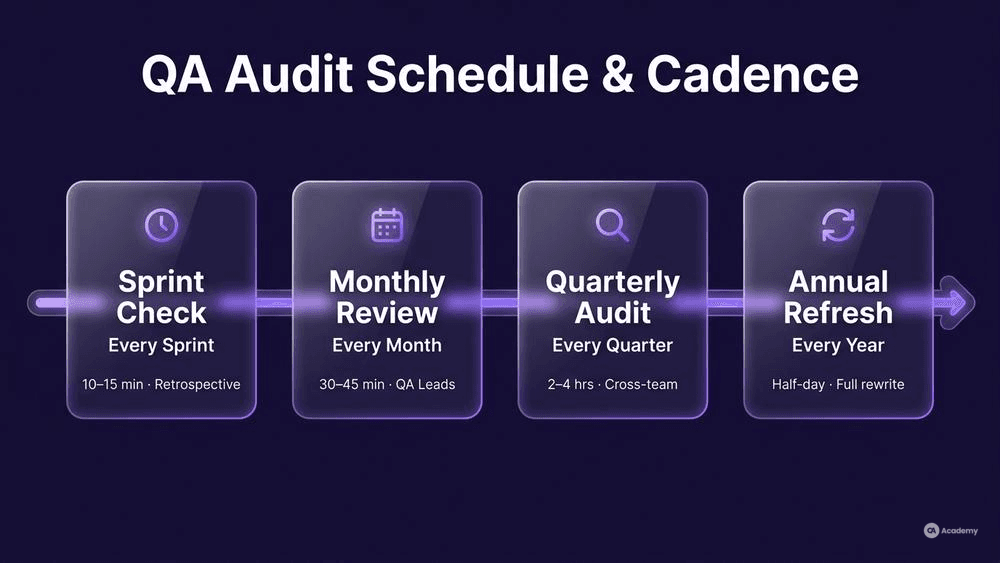
An audit schedule does not have to mean formal, external audits with clipboards. For most Scrum teams, it means structured checkpoints where someone deliberately looks at whether the process is working.
Recommended cadence:
Checkpoint | Cadence | Format | Duration |
|---|---|---|---|
Sprint process check | Every sprint | Added to retrospective agenda | 10–15 min |
Monthly assurance review | Monthly | Dedicated review meeting with QA leads | 30–45 min |
Quarterly deep audit | Quarterly | Cross-team or external review of key processes | 2–4 hours |
Annual plan refresh | Annually | Full assurance plan review and rewrite | Half-day workshop |
Sprint process checks are the lightest touch: during your retrospective, add one standing question — "Did we follow our own testing process this sprint? Where did we deviate, and was that deviation justified?"
Monthly review meetings dig deeper. Review your compliance verification results, look for trends (are the same environment issues recurring?), and update quality gate criteria if your risk profile has changed.
Quarterly deep audits are where you bring in a fresh perspective. Have someone from another team review your test artifacts, or use a self-assessment against a maturity model like TMMi [2].
Common Pitfalls and How to Avoid Them
Pitfall 1: Building a Plan Nobody Reads
A lengthy assurance plan that is not regularly referenced can become less effective than no plan at all—because it creates a false sense of security. Keep it short. If it exceeds 4 pages, you are likely documenting process details that belong in your test strategy, not in the assurance plan.
Pitfall 2: Relying Solely on Self-Assessment
In many team contexts, people tend to under-report their own process gaps, particularly under deadline pressure. Balance self-assessment with peer reviews and cross-team audits. Independent eyes catch what familiarity blinds you to.
Pitfall 3: Treating Assurance as Separate from Delivery
If your assurance activities live outside your sprint workflow, they will always be the first thing cut when time runs short. Embed them into existing ceremonies—retrospectives, sprint reviews, and release readiness checks.
Pitfall 4: Measuring Activity Instead of Outcome
Tracking "number of audits completed" tells you nothing about process health. Instead, track:
- Defects escaped to production that a process check should have caught
- Quality gate override frequency and reasons
- Time to resolve audit findings (are they getting fixed or just logged?)
Pitfall 5: Freezing the Plan
Your product changes. Your team changes. Your risk profile changes. An assurance plan that was accurate six months ago may no longer address your team's current challenges. Build in a mandatory refresh trigger—either calendar-based (quarterly) or event-based (after a major release, team restructuring, or production incident).
Real-World Example
⚠️ Disclaimer: The following scenario is an illustrative example based on typical industry patterns. The specific metrics are hypothetical estimates designed to demonstrate realistic outcomes, not measured data from a documented project. They should not be cited as factual benchmarks.
Context
A mid-sized fintech company with four Scrum teams sharing a single product had no formal assurance plan. Each team followed its own interpretation of the test strategy. Test environment conflicts occurred frequently, regression suites varied in coverage, and defect triage processes differed across teams.
Challenge
After two consecutive releases with critical production defects that traced back to process inconsistencies (not missing tests, but tests run against a misconfigured environment in one case and an outdated regression suite in another), the QA Director needed a way to standardize process quality without slowing delivery.
Solution
The team implemented a lightweight assurance plan with three core elements:
- Unified quality gate criteria across all four teams, risk-tiered by release type (see the tier structure described earlier).
- Sprint-level process checks added to retrospectives—a 10-minute standing agenda item reviewing process adherence.
- Monthly cross-team audits where one team's Test Lead reviewed another team's test artifacts, environment configurations, and defect workflows.
The assurance plan itself was a 3-page Confluence document, jointly owned by all four Test Leads with quarterly refresh cycles.
Results (Illustrative)
Over six months, the team observed:
- Production defects attributable to process failures dropped by approximately 65%.
- Environment-related test delays decreased by roughly 70% once environment health checks became a weekly assurance activity.
- Cross-team audits surfaced 12 process improvement actions in the first quarter, 8 of which were implemented within the same quarter.
- Quality gate override frequency was tracked for the first time, revealing that one team was overriding gates in 40% of sprints—triggering a focused process improvement initiative.
Key Takeaways
- Start with pain points, not frameworks. The team scoped their assurance plan around the two failure modes that had actually caused production incidents, rather than trying to audit everything.
- Cross-team visibility was the biggest win. Simply having another team look at your process surfaced blind spots that months of self-assessment had missed.
- Tracking gate overrides changed behavior. Making override patterns visible created accountability without adding process overhead.
- The 3-page limit was intentional. The QA Director explicitly capped the plan length to prevent it from becoming another unread document.
One observation worth considering: the cross-team audit model works well when teams operate on similar tech stacks and processes. In organizations with highly heterogeneous teams, you may need domain-specific checklists to make cross-audits meaningful rather than superficial.