



Your test plan says the staging environment will mirror production. Your team believes the API response times will stay under 200ms. The product owner assures you that the payment module won't change before release. But what happens when none of that turns out to be true? Those hidden beliefs—the ones nobody writes down—are where escaped defects are born. An assumption log gives your QA team a single, living document to capture, track, and validate the unverified beliefs that silently shape your test strategy. In this article, you'll get a ready-to-use template, a step-by-step workflow, and field-tested practices for making assumption tracking a core part of your STLC. You'll also find a challenge: redesigning how your team connects assumptions to risk and test coverage in a way no template can prescribe.
What Is an Assumption Log?
An assumption log is a structured record of unverified beliefs, conditions, or expectations that your team treats as true during planning, test design, or execution. According to the ISTQB glossary, a test condition is a "testable aspect of a component or system identified as a basis for testing" [1]. Assumptions sit one layer beneath those conditions—they are the unstated premises that determine which test conditions you identify in the first place.
Think of it as a project constraint list for things you believe but haven't confirmed. Each entry captures the assumption itself, who raised it, the current validation status, the potential impact if wrong, and the owner responsible for verifying it.
Why It Matters for QA and the STLC
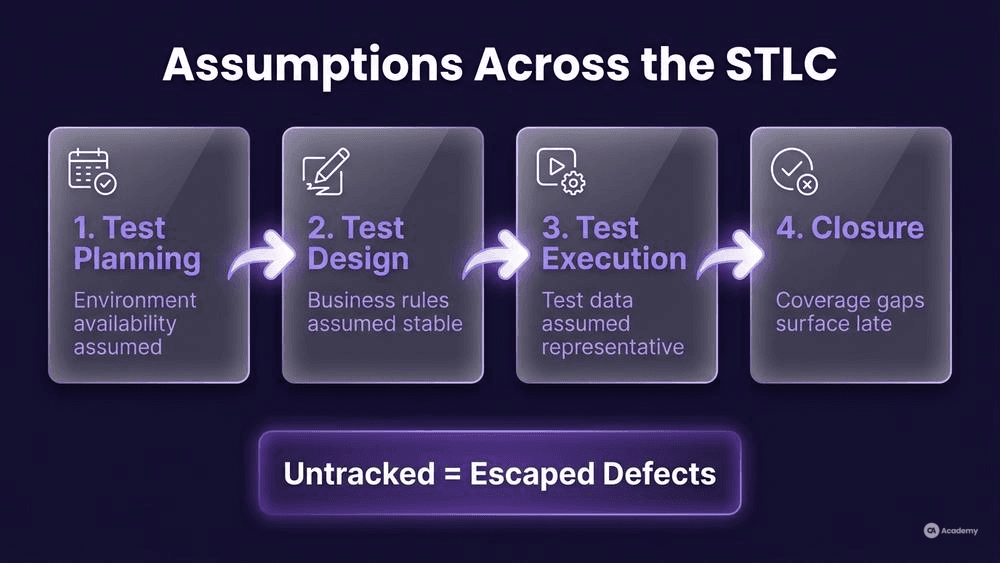
Assumptions influence nearly every phase of the Software Testing Life Cycle. During test planning, you assume certain environments will be available. During test design, you assume specific business rules are stable. During execution, you assume test data will be representative.
When those beliefs go untracked, the consequences are predictable: test coverage gaps, late-cycle defect escapes, and scope disputes that burn sprint velocity. ISO/IEC/IEEE 29119-3 defines the structure and content of test documentation, including the test plan, which should reference the conditions and constraints under which testing operates [2]. An assumption log feeds directly into that documentation by making implicit constraints explicit.
The log also functions as a decision basis record. When a stakeholder asks, "Why didn't you test the payment gateway under load?"—and the answer is, "Because we assumed the vendor guaranteed 99.9% uptime"—that entry in your log turns a blame conversation into a process improvement conversation.
How to Build and Maintain an Assumption Log
Prerequisites and Setup
Before you create your first entry, align on three things:
- Ownership model. Decide who can add entries, who validates them, and who closes them. In most Scrum teams, the QA Lead or Test Manager owns the log, but ideally any team member involved in the testing process should be able to contribute entries.
- Storage location. The log must live where your team already works—Confluence, Jira, Notion, or a shared spreadsheet. A log nobody opens is worse than no log at all.
- Review cadence. Tie assumption reviews to existing ceremonies. Sprint planning and test plan reviews are natural checkpoints.
Step 1: Identify Assumptions
Start by asking the team: "What are we treating as true without evidence?" Use these prompts to surface hidden beliefs:
- What environment conditions are we taking for granted?
- Which requirements do we consider stable and unlikely to change?
- What do we assume about third-party dependencies, APIs, or data feeds?
- What performance or capacity thresholds are we assuming?
Capture each answer as a separate log entry.
Step 2: Classify and Prioritize
Not all assumptions carry equal risk. Classify each entry by:
- Impact if wrong: High / Medium / Low — what breaks if this belief is false?
- Likelihood of being wrong: Based on historical data or team judgment.
- STLC phase affected: Planning, design, execution, or closure.
High-impact, high-likelihood entries become risk register inputs. They should trigger explicit validation tasks in your sprint backlog.
Step 3: Assign Validation Owners
Each assumption needs a named owner and a target validation date. "The team" is not an owner. A person is.
Step 4: Validate or Invalidate
Validation can mean different things depending on the assumption:
- Environment assumptions: Run a smoke test against the actual environment.
- Requirements assumptions: Get written confirmation from the product owner.
- Performance assumptions: Execute a focused performance test or review vendor SLAs.
When an assumption is validated, update the status and close the entry. When invalidated, trigger a change to your test plan, test cases, or risk register.
Step 5: Review and Maintain
At each sprint boundary, review open entries. Ask: Has anything changed? Are there new assumptions from the latest backlog refinement? Archive closed entries for traceability, but keep the log lean.
Template: Assumption Log Entry
Field | Description | Example |
|---|---|---|
ID | Unique identifier | ASSM-042 |
Date Raised | When the assumption was logged | 2026-03-15 |
Raised By | Person who identified it | Test Lead |
Assumption | Clear statement of the belief | Staging DB schema matches production |
Category | Environment / Requirement / Data / Dependency / Performance | Environment |
Impact if Wrong | What happens if the assumption fails — state the specific downstream consequence | Test results become unreliable; likely regression of 5+ critical flows needs re-execution |
Likelihood | High / Medium / Low | Medium |
Validation Method | How will we confirm or deny this? | Compare schemas using diff tool before test cycle |
Owner | Person responsible for validation | DevOps Engineer |
Target Date | Deadline for validation | 2026-03-22 |
Status | Open / Validated / Invalidated / Deferred | Open |
Linked Risk | Reference to risk register entry if applicable | RISK-018 |
Best Practices for Effective Assumption Tracking
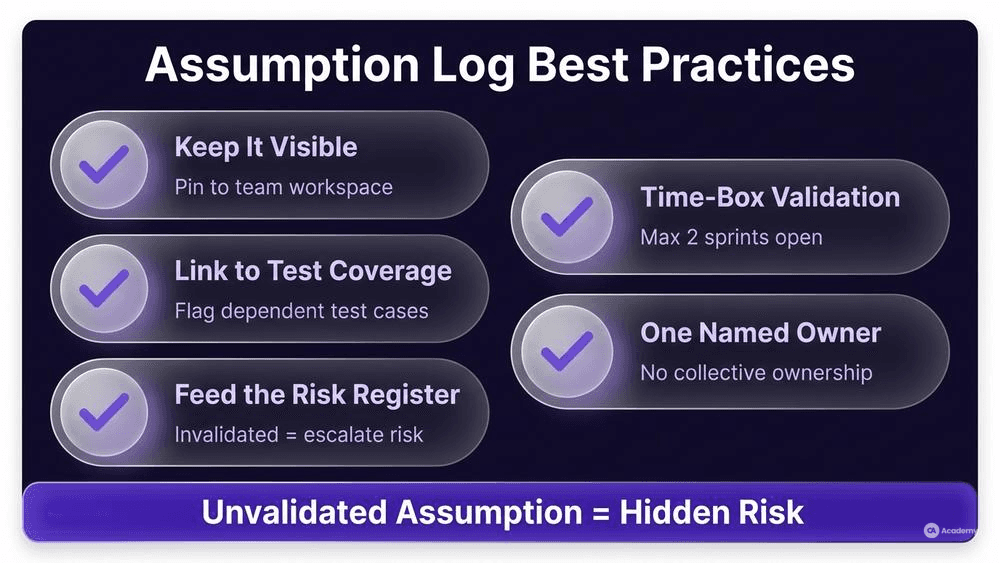
1. Keep the log visible, not buried. A log stored in a folder three clicks deep will be forgotten. Pin it to your team's Confluence space, link it from your test plan, or embed a Jira dashboard widget that surfaces open assumptions.
2. Connect assumptions to test coverage. For each high-impact assumption, identify the test cases or test suites that depend on it. If the assumption is invalidated, you immediately know which tests need revision. ISO/IEC/IEEE 29119-2 defines test process activities including test design and test execution [3]—your assumption log should feed directly into those activities by flagging which design decisions rest on unverified ground.
3. Use assumptions as risk register inputs. A high-impact, unvalidated assumption is functionally a risk. Create a direct link between your assumption log and your risk register. When an assumption moves to "Invalidated," the corresponding risk entry should be escalated automatically or during the next review.
4. Time-box validation. An assumption that has been "open" for three sprints without validation is either irrelevant or being ignored. Set a maximum age policy—for instance, no assumption remains open for more than two sprints without an explicit deferral decision.
5. Challenge your team to redesign the integration. Here's where most teams plateau: they build the log but treat it as a standalone artifact. The real leverage comes from designing a feedback loop where invalidated assumptions automatically update your test strategy, traceability matrix, and sprint retrospective actions. Ask your team: "If our three highest-impact assumptions all failed simultaneously, would our current process catch the cascade?" That question is worth a retro session on its own.
What Not to Do: Common Pitfalls
Knowing what to avoid is often more valuable than knowing what to do. Here are patterns that consistently undermine assumption tracking:
- Don't confuse assumptions with risks. An assumption is something you believe to be true. A risk is a potential event with negative consequences. They are related—an invalidated assumption can become a risk—but they are not interchangeable. Mixing them in a single register muddies both.
- Don't log everything. If you log trivial beliefs ("We assume the CI pipeline will be available"), you'll drown in noise. Focus on assumptions that, if wrong, would materially change your test approach or coverage.
- Don't skip the "Impact if Wrong" column. Without it, you have a list of beliefs with no basis for prioritization. The impact statement is what transforms a passive record into an actionable unknown factor tracking tool.
- Don't let the log become write-only. A log that gets entries but never gets reviewed is a compliance artifact, not a testing tool. If your team isn't revisiting and closing entries, the practice has failed.
- Don't assign "the team" as owner. Collective ownership means no ownership. Each entry needs a single accountable person—even if that person delegates the validation work.
Tools Comparison
Tool | Format | Best For | Limitation |
|---|---|---|---|
Jira (custom issue type or label) | Structured tickets with workflow | Teams already in Jira; links to stories, risks, and test cases | Requires configuration; can clutter the backlog without filters |
Confluence (table or database macro) | Wiki-style table with status tracking | Lightweight documentation alongside test plans | No automated workflow; manual status updates |
Notion (database view) | Flexible database with relations | Small to mid-size teams wanting visual boards and linked databases | Limited integration with dedicated test management tools |
Microsoft Excel / Google Sheets | Spreadsheet with filters | Quick setup; works for any team size | No traceability links; version control is manual |
Azure DevOps (work item type) | Structured work items with states | Microsoft-stack teams; integrates with Azure Test Plans | Requires admin setup for custom work item types |
Choose the tool that lives where your team already works. The best assumption log is the one your team actually opens.
Real-World Example
⚠️ Disclaimer: The following scenario is an illustrative example based on typical industry patterns. The specific metrics are hypothetical estimates designed to demonstrate realistic outcomes, not measured data from a documented project. They should not be cited as factual benchmarks.
Context
A mid-size fintech team (6 developers, 2 QA engineers, 1 test lead) was delivering a payment processing module across four-week sprints. Their test plan documented scope, schedule, and environments—but not the beliefs underlying those decisions.
Challenge
During the third sprint, the team discovered that the payment gateway's sandbox environment did not support a recently introduced transaction type. This assumption—that the sandbox was feature-complete—had never been recorded. The result: 12 test cases had to be redesigned, execution slipped by four days, and two defects escaped to production because the affected flows were deprioritized under time pressure.
Solution
Starting from the next sprint, the test lead introduced an assumption log using a Jira custom issue type with a dedicated "Assumption" label. The workflow included:
- Capture during backlog refinement and sprint planning.
- Classify by impact and STLC phase.
- Assign a validation owner and target date for each entry.
- Review at every sprint boundary and test plan update.
- Link high-impact entries to the risk register and affected test suites.
Results (Illustrative)
Over the following three sprints:
- The team logged 23 assumptions, of which 5 were invalidated before test execution began—allowing proactive test plan adjustments.
- Late-cycle test redesigns dropped by approximately 70%.
- Escaped defects related to environmental or dependency mismatches decreased by roughly 60%.
- Sprint planning discussions became more focused, as the log surfaced hidden unknowns early.
Key Takeaways
- The highest-value assumptions to track are those related to environments and third-party dependencies—these are the beliefs most frequently invalidated.
- Linking assumptions to specific test suites created a rapid response path when a belief proved false.
- The log's greatest impact was cultural: it gave the team a shared vocabulary for uncertainty and made it safe to say, "I don't actually know if that's true."