



You have spent years writing test cases, debugging pipelines, and catching defects before they reach production. But when a recruiter scans your profile or a hiring manager compares two equally skilled candidates, a recognized IT certification often tips the scale. Certifications do not replace hands-on skill — yet they provide a structured way to validate what you already know and fill gaps you may not realize you have. This article walks you through how to choose, prepare for, and extract real value from QA-focused credentials. You will find a decision framework, a preparation workflow you can start using today, and common anti-patterns that waste both time and money.
What Is an IT Certification in the QA Context?
An IT certification is a formal credential issued by an accredited body that confirms your competence in a specific domain — in this case, software testing and quality assurance. Unlike a university degree, a certification typically targets a focused skill set and requires periodic renewal, which keeps your knowledge current.
For QA professionals, the most relevant certifications come from bodies such as ISTQB, which defines standardized testing terminology and techniques across its Foundation, Advanced, and Expert levels [1]. These credentials map directly to international standards like ISO/IEC/IEEE 29119, which codifies test processes, documentation, and techniques [2], [3], [4].
Why IT Certification Matters for QA
Certifications serve three practical purposes in a QA career:
- Common vocabulary. When your entire team speaks the same testing language — distinguishing, for example, between confirmation testing and regression testing as defined by the ISTQB glossary [5] — miscommunication drops. Defect reports become clearer, and handoffs between testers and developers become smoother.
- Structured skill validation. A credential from a recognized body signals that you can apply specific test design techniques — equivalence partitioning, boundary value analysis, cause-effect graphing — not just describe them. This matters when you are joining a new team or moving into a test lead role.
- Career mobility. Many organizations, especially in regulated industries like automotive (Automotive SPICE [6]) or finance, list ISTQB or equivalent certification as a baseline requirement for QA roles. Having the credential removes a filter that could otherwise exclude you early in the hiring process.
That said, certification alone does not guarantee competence. A credential without consistent practical application can lose relevance over time. The value compounds when you actively apply what you learn to your daily testing work.
How to Choose the Right Credential
Not every certification delivers the same return for every tester. The choice depends on where you are in your career, what domain you work in, and what skill gaps you actually need to close.
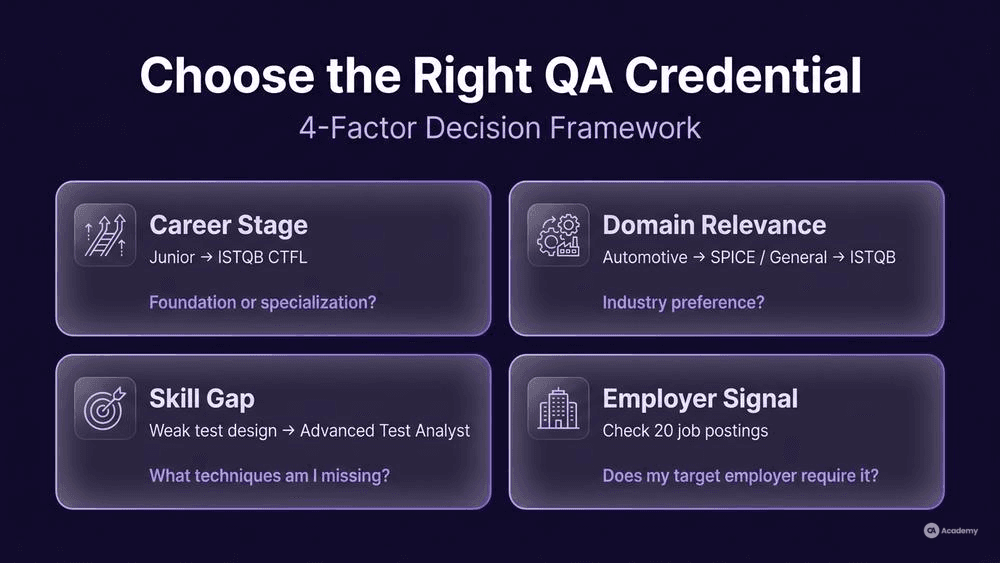
Decision Framework: Four Factors
Use this framework to narrow your options before committing time and money:
Factor | Question to Ask Yourself | Example |
|---|---|---|
Career stage | Am I building a foundation or deepening a specialization? | Junior → ISTQB CTFL; Senior → ISTQB Advanced Test Analyst |
Domain relevance | Does my industry require or prefer specific credentials? | Automotive → Automotive SPICE; General QA → ISTQB |
Skill gap | What specific techniques or processes am I weakest in? | Weak in test design → ISTQB Advanced Test Analyst [7] |
Employer signal | Does my current or target employer recognize this credential? | Check job postings for required/preferred certifications |
If-Then Selection Guide
- If you have fewer than two years of testing experience and no formal credential, then start with ISTQB Certified Tester Foundation Level (CTFL) v4.0 [1]. It covers fundamental test processes, techniques, and terminology that align with ISO/IEC/IEEE 29119 [2].
- If you are an SDET or automation engineer and your gap is in test design theory rather than tooling, then the ISTQB Advanced Level Test Analyst [7] fills that gap with structured coverage of techniques like cause-effect graphing and state transition testing.
- If you work in an Agile team and need to formalize your understanding of testing within Scrum or Kanban, then the ISTQB Foundation Level Agile Tester [8] is purpose-built for that context.
- If your organization is pursuing process maturity, then consider aligning your professional development with TMMi [9], which provides a maturity model specifically for test processes.
Certification Exam Preparation Workflow
Knowing which certification to pursue is only the first step. How you prepare determines whether you pass efficiently — and, more importantly, whether you retain and apply the knowledge afterward.
Prerequisites and Setup
Before you open a study guide, complete these steps:
- Download the official syllabus. For ISTQB certifications, the syllabus is freely available on the ISTQB website [1], [7], [8]. This is your primary study material — not a substitute blog post or summary video.
- Map syllabus sections to your experience. Mark each learning objective as "strong," "moderate," or "weak." This prevents you from spending equal time on topics you already know well.
- Set a realistic timeline. For ISTQB CTFL, most testers with two-plus years of experience need four to six weeks of consistent study. For Advanced levels, plan eight to twelve weeks.
- Choose your study format. Options include professional development courses (instructor-led or self-paced), study groups, or self-study with practice exams. The best format depends on your learning style — there is no universally superior approach.
Step-by-Step Preparation
Week 1-2: Foundation Pass
Read the entire syllabus end-to-end without trying to memorize. Your goal is to understand the structure and identify where your knowledge gaps are largest.
Week 3-4: Deep Dive on Weak Areas
Focus your study sessions on the sections you marked as "weak." For each learning objective:
- Read the syllabus explanation
- Find or create a practical example from your own project work
- Write one practice question and answer it without notes
Week 5-6: Practice Exams and Spaced Review
Take at least three full-length practice exams under timed conditions. Review every wrong answer — not just the correct option, but why each distractor is wrong. This reinforces the underlying concept rather than just pattern-matching answers.
Practical tip: For most individuals, consistency outperforms intensity in exam preparation. Thirty minutes daily over six weeks typically produces better retention than weekend-long cramming sessions, because spaced repetition strengthens long-term recall.
Common Pitfalls in Preparation
- Relying solely on brain dumps. Memorizing answers to leaked questions may help you pass, but it undermines the entire purpose of certification — actual skill development. You will struggle to apply the knowledge in real projects.
- Skipping the official syllabus. Third-party study guides can be helpful supplements, but they sometimes simplify or misrepresent official terminology. The syllabus is the authoritative source.
- Ignoring practical application. After each study session, try applying one concept to your current project. If you study equivalence partitioning, apply it to a test case you are writing that week.
Industry Recognized Credentials Compared
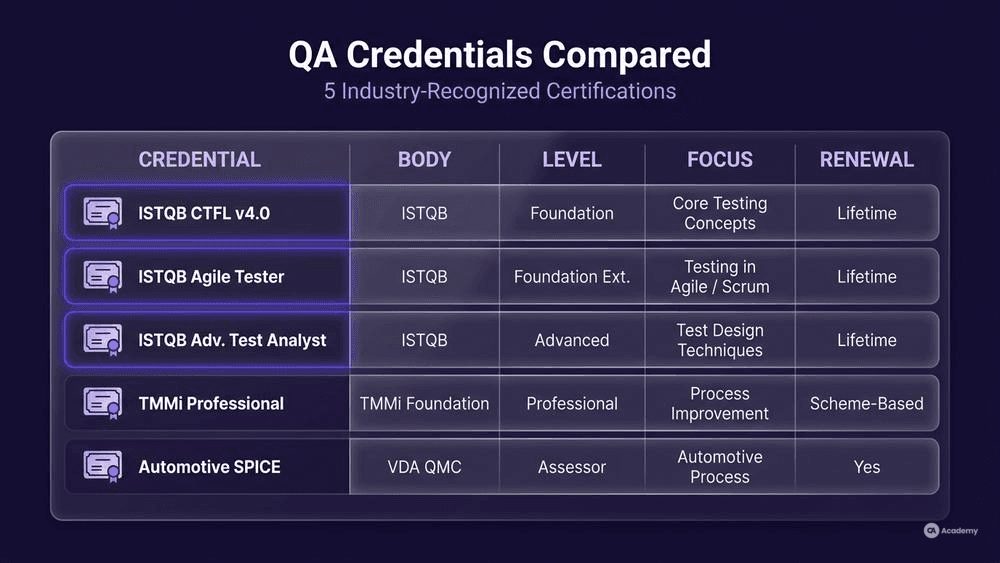
The table below compares the most relevant skill validation programs for QA professionals. All listed credentials are real, verifiable, and actively maintained by their respective organizations.
Credential | Issuing Body | Level | Focus Area | Renewal Required? |
|---|---|---|---|---|
ISTQB CTFL v4.0 [1] | ISTQB | Foundation | Core testing concepts, processes, techniques | No (lifetime) |
ISTQB Agile Tester [8] | ISTQB | Foundation Extension | Testing in Agile/Scrum contexts | No (lifetime) |
ISTQB Advanced Test Analyst [7] | ISTQB | Advanced | Test design techniques, reviews, test management | No (lifetime) |
TMMi Professional [9] | TMMi Foundation | Professional | Test process improvement and maturity | Depends on scheme |
Automotive SPICE Assessor [6] | VDA QMC | Assessor | Process assessment in automotive domain | Yes |
Key considerations when comparing:
- ISTQB credentials have the broadest international recognition. They are vendor-neutral and map to ISO/IEC/IEEE 29119 standards, which makes them transferable across industries and toolchains.
- TMMi is most valuable when your organization is actively pursuing test process improvement. It complements individual ISTQB credentials by providing an organizational maturity perspective.
- Automotive SPICE is domain-specific. If you do not work in automotive or an adjacent regulated industry, it is unlikely to provide significant career leverage.
Be cautious about certifications from tool vendors that primarily validate product knowledge rather than transferable testing skills. A vendor badge may help within a specific toolchain, but it rarely carries the same weight as a body-of-knowledge credential from an independent standards organization.
Real-World Example: Certification-Driven Team Improvement
⚠️ Disclaimer: The following scenario is an illustrative example based on typical industry patterns. The specific metrics are hypothetical estimates designed to demonstrate realistic outcomes, not measured data from a documented project. They should not be cited as factual benchmarks.
Context
A mid-sized financial services company had a QA team of twelve testers. The team had strong domain knowledge but inconsistent testing practices — different testers used different terminology for severity levels, defect reports varied widely in quality, and test design relied heavily on individual intuition rather than structured techniques.
Challenge
The team struggled with three recurring issues:
- Defect reports were frequently returned by developers for clarification, creating rework and friction
- New testers took months to reach full productivity because there was no shared framework for how testing was done
- Test coverage gaps appeared repeatedly in the same functional areas, suggesting that test design was inconsistent
Solution
The team lead implemented a two-phase approach:
Phase 1 — Baseline Certification: All twelve testers completed ISTQB CTFL within a three-month window. The team used the syllabus terminology as the basis for updating their defect report template, test case standards, and severity classification scheme.
Phase 2 — Specialized Depth: Four senior testers pursued the ISTQB Advanced Test Analyst credential, focusing specifically on structured test design techniques. They then led internal workshops to apply equivalence partitioning, boundary value analysis, and state transition testing to the team's highest-risk modules.
Results
After six months:
- Defect report rework dropped by an estimated 55%, because the team adopted standardized terminology and a consistent report structure based on syllabus definitions
- New hire onboarding time decreased by roughly 40%, as the certification syllabus provided a shared baseline that supplemented domain-specific training
- The team identified and closed coverage gaps in three critical modules by systematically applying test design techniques from the Advanced syllabus
Key Takeaways
- Certification delivered the most value when the team applied it collectively, not individually. A shared vocabulary reduced friction across the entire workflow.
- The Advanced credential was most impactful for senior testers who could immediately apply structured techniques to existing test suites.
- Certification was a catalyst, not a solution by itself. The team still needed to update their processes, templates, and review practices to realize the benefits.
What Not to Do: Certification Anti-Patterns
Avoiding common mistakes is as important as following best practices. Here are the most damaging anti-patterns in certification strategy:
Anti-Pattern 1: Collecting Credentials Without Application
Some testers pursue multiple certifications as resume padding without ever applying the techniques in their daily work. This creates a false sense of expertise and can actually harm credibility if you cannot demonstrate practical application during a technical interview.
Instead: After earning each credential, identify three specific techniques or practices from the syllabus and integrate them into your current project within 30 days.
Anti-Pattern 2: Pursuing Certifications Your Industry Does Not Value
Investing in a highly specialized credential that your target employers do not recognize wastes time and money. For example, pursuing an automotive-specific process assessment certification when you work exclusively in e-commerce testing provides limited career leverage.
Instead: Before committing to any certification, review at least twenty job postings for roles you want next. Count how many mention the credential you are considering.
Anti-Pattern 3: Substituting Certification for Experience
A certification proves you understand concepts in a controlled exam environment. It does not prove you can debug a flaky CI pipeline at 2 AM or navigate a complex stakeholder disagreement about release readiness. Employers value the combination of credentials and demonstrated project experience.
Instead: In your resume and interviews, pair each certification with specific project outcomes where you applied the knowledge. "ISTQB Advanced Test Analyst — applied state transition testing to reduce payment gateway defects by identifying missed state combinations" is far more compelling than listing the credential alone.
Anti-Pattern 4: Ignoring Process Maturity Context
Individual certifications improve personal capability, but they may not move the needle for your team if the organizational test process is immature. If your team lacks basic test planning and exit criteria, an individual Advanced certification will not compensate for the structural gap.
Instead: Assess your team's process maturity against a framework like TMMi [9] and determine whether the priority is individual skill development or organizational process improvement. Often, both are needed, but sequencing matters.