



Career opportunities in QA testing have never been more diverse. If you are a manual tester wondering what comes next, or an automation engineer exploring a lateral move, the testing landscape offers multiple distinct paths. This article maps out every major role, the skills each one demands, and a concrete plan you can start executing this week. You will walk away with a clear picture of where QA careers are heading and how to position yourself for the roles that match your strengths.
Why QA Career Planning Matters Now
The software testing profession is shifting from execution-heavy manual work toward engineering-oriented, risk-based quality practices. Standards such as ISO/IEC/IEEE 29119-2:2021 formalize test processes that organizations increasingly expect QA professionals to design, not merely follow [1]. If you are not actively steering your career, you risk being steered by organizational restructuring.
Modern quality assurance sits at the intersection of development, operations, and security. That means your next role might look nothing like your current one. Understanding the full spectrum of test engineer roles, quality analyst positions, and automation specialist jobs lets you make deliberate choices rather than reactive ones.
The professionals who advance fastest treat career development like a test strategy: assess the current state, identify gaps, define acceptance criteria for the next milestone, and iterate.
Core QA Roles and What They Actually Involve
Not every QA job is the same, despite what some job boards suggest. Here is what each major role actually requires day-to-day.
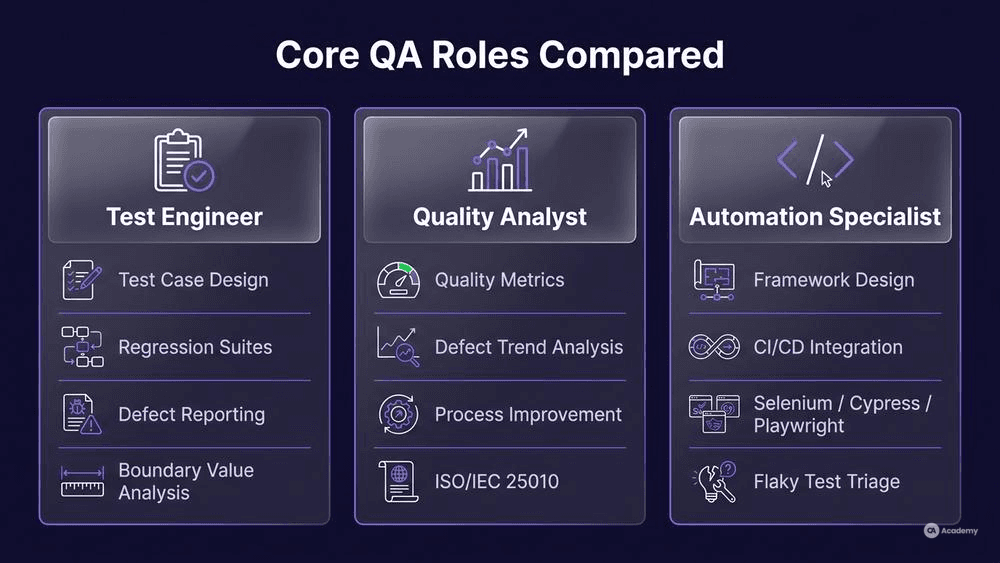
Test Engineer Roles
Test engineers own the design and execution of test suites. You write test cases grounded in techniques defined in ISO/IEC/IEEE 29119-4:2021 [2], maintain traceability, and report defects with enough context for developers to reproduce them in one attempt.
A typical week involves reviewing requirements, designing boundary value and equivalence partitioning tests, running regression suites, and triaging failures. You need solid analytical skills and enough domain knowledge to spot risks that automated checks miss.
Quality Analyst Positions
Quality analysts focus on process rather than individual test execution. You define quality metrics, monitor defect trends, and advise teams on where their process is leaking value. This role often requires familiarity with product quality models such as ISO/IEC 25010:2023, which defines characteristics like functional suitability, reliability, and security [3].
If you enjoy looking at systems rather than individual test cases, quality analyst positions reward that perspective.
Automation Specialist Jobs
Automation specialists build and maintain test frameworks. You select tools, design page object models or API test layers, integrate suites into CI/CD pipelines, and troubleshoot flaky tests. Most organizations expect proficiency in at least one programming language (Java, Python, JavaScript, or C#) and hands-on experience with frameworks like Selenium, Cypress, or Playwright.
The distinction between an automation specialist and an SDET is often organizational. In many companies, the automation specialist is framework-focused while the SDET contributes to production code as well.
High-Demand QA Skills That Drive Hiring Decisions
Certifications open doors, but specific skills close offers. Here are the competencies that consistently appear in competitive QA job listings.
Skill Category | Specific Skills | Why It Matters |
|---|---|---|
Test Design | Boundary value analysis, state transition, decision tables | Structured techniques catch defects that ad hoc testing misses [2] |
Automation | Selenium, Cypress, Playwright, REST Assured | Framework proficiency is expected for most mid-level and senior roles |
CI/CD Integration | Jenkins, GitHub Actions, GitLab CI | Testers who can pipeline their suites reduce feedback loops |
API Testing | Postman, REST Assured, contract testing | Microservice architectures make API testing essential |
Security Fundamentals | OWASP Top 10:2025, threat modeling | Security-aware testers reduce the risk of critical vulnerabilities reaching production [4] |
Performance Testing | k6, JMeter, Gatling | Load and stress testing protects revenue-critical systems |
The strongest candidates combine two or three of these categories. For example, a tester who understands both API automation and security fundamentals is significantly harder to replace than one who knows only UI automation.
Certifications That Carry Weight
The ISTQB Certified Tester Foundation Level (CTFL) v4.0 remains the most widely recognized QA certification globally and validates foundational test knowledge [5]. For testers working in agile environments, the ISTQB Foundation Level Agile Tester (CTFL-AT) extension adds credibility [6]. At the advanced level, the ISTQB Test Analyst certification demonstrates depth in test design techniques and is valued for senior quality analyst positions [7].
These certifications matter most when combined with demonstrable practical experience. A CTFL paired with a public GitHub repository of automation projects signals both knowledge and execution ability.
SDET Career Outlook and the Shift Toward Engineering
The SDET career outlook remains strong because the role sits exactly where organizations need the most help: bridging the gap between development speed and quality confidence. SDETs write production-grade test code, contribute to testability improvements in the application itself, and often own quality tooling that the entire team depends on.
What distinguishes SDETs from automation specialists is scope. SDETs typically review pull requests, refactor application code for testability, and participate in architectural decisions. Many organizations report that SDETs tend to receive compensation packages closer to software developer levels than to traditional tester levels, reflecting the hybrid skill set the role demands.
Where SDET Roles Are Growing
SDET demand is particularly visible in organizations running microservice architectures, where contract testing, service virtualization, and distributed tracing require engineering depth. Fintech, healthtech, and SaaS platforms with continuous deployment pipelines are among the sectors recruiting SDETs most actively.
If you are considering this path, invest in learning one strongly-typed language (Java or C#) alongside your test automation framework. Understanding design patterns (Page Object, Screenplay, Builder) and being comfortable reading production code are non-negotiable prerequisites.
Manual Tester Demand in a World of Automation
Manual tester demand has not disappeared—it has transformed. Pure click-through execution roles are declining, but exploratory testing, usability testing, and domain-specific validation remain fundamentally human activities.
The testers who thrive are the ones who position manual testing as a complement to automation rather than a replacement for it. You explore edge cases that automated suites do not cover. You evaluate user experience in ways that assertions cannot capture. You apply domain expertise to identify risks that are invisible to someone writing tests from specifications alone.
How to Stay Competitive as a Manual Tester
- Learn structured exploratory testing: Use session-based test management with charters, time-boxes, and debrief notes.
- Build domain expertise: Deep knowledge of healthcare regulations, financial compliance, or e-commerce workflows makes you irreplaceable.
- Add light automation skills: Writing basic API tests in Postman or contributing to Cypress specs shows willingness to grow without requiring a full engineering pivot.
- Document your impact: Track the defects your exploratory sessions uncover that automated suites missed. This data justifies your role during staffing discussions.
How to Build a 90-Day Career Acceleration Plan
Instead of vague resolutions, use this structured plan to make measurable progress in one quarter.
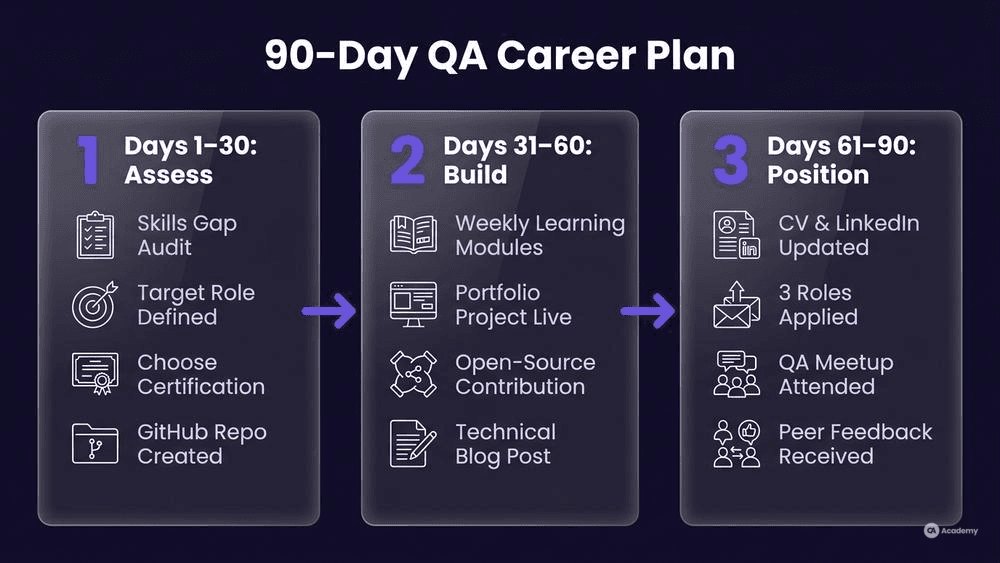
Days 1–30: Assess and Target
- Audit your current skills against the table in the "High-Demand QA Skills" section above.
- Identify two skill gaps that appear in job postings for your target role.
- Select one certification to pursue (CTFL v4.0 if you lack it, CTFL-AT or Test Analyst if you have it) [5], [6], [7].
- Set up a public GitHub repository for your learning projects.
Days 31–60: Build and Practice
- Complete one online course or self-study module per week on your identified skill gaps.
- Build a portfolio project: automate a public API (e.g., the Restful Booker API) with a framework relevant to your target role.
- Contribute to one open-source testing project (even documentation improvements count).
- Write one technical blog post or LinkedIn article about something you learned.
Days 61–90: Position and Connect
- Update your CV/LinkedIn to reflect new skills with evidence (repository links, certification numbers).
- Apply to three targeted positions or internal transfer opportunities.
- Attend one QA meetup or conference (virtual or in-person) and connect with at least five professionals.
- Request feedback on your portfolio project from a senior QA professional.
This plan works because it combines skill acquisition with visible proof and professional networking—the three elements that hiring managers evaluate.
Common Career Mistakes to Avoid
Knowing what not to do is often as valuable as knowing what to do. These are the patterns that stall QA careers.
- Staying in one domain too long without expanding skills. Five years of the same manual regression testing is one year of experience repeated five times. Seek lateral moves or side projects that stretch your capabilities.
- Chasing tools instead of fundamentals. A new framework launches every quarter. The tester who understands test design principles from ISO/IEC/IEEE 29119-4:2021 [2] can learn any tool quickly. The tester who only knows one tool's API is stuck when that tool falls out of favor.
- Ignoring soft skills. QA professionals who cannot communicate risk to stakeholders, facilitate defect triage meetings, or mentor junior testers hit a ceiling below management and lead roles regardless of their technical depth.
- Skipping documentation of your impact. If you cannot quantify the defects you prevented, the test coverage you improved, or the pipeline time you reduced, your contributions become invisible during promotion reviews.
- Assuming automation replaces your role rather than augmenting it. Automation replaces repetitive execution. It does not replace risk assessment, exploratory investigation, or stakeholder communication.
Real-World Career Transition Scenario
⚠️ Disclaimer: The following scenario is an illustrative example based on typical industry patterns. The specific metrics are hypothetical estimates designed to demonstrate realistic outcomes, not measured data from a documented project. They should not be cited as factual benchmarks.
Context
A mid-career manual tester at a mid-sized SaaS company had five years of experience executing regression test suites for a web application. The organization was shifting toward continuous delivery and announced that several manual testing positions would be restructured.
Challenge
The tester needed to transition from manual test execution to an automation-capable role within six months. The immediate barriers included no programming experience, no CI/CD pipeline knowledge, and no portfolio demonstrating automation capability.
Solution
The tester followed a structured plan similar to the 90-day framework described above, extended to accommodate the programming learning curve:
- Months 1–2: Completed a Python fundamentals course and earned the ISTQB CTFL v4.0 certification.
- Months 2–4: Built a Selenium-based automation framework for the team's existing regression suite, starting with the ten highest-priority test cases.
- Months 4–5: Integrated the automated suite into the team's Jenkins pipeline with nightly scheduled runs.
- Month 6: Documented the framework, trained two colleagues, and applied for an internal automation specialist position.
Results
- Automated regression execution time decreased from approximately 3 days of manual effort to 45 minutes of automated execution.
- The team's defect escape rate to production decreased by an estimated 60%.
- The tester secured the internal automation specialist position with a compensation adjustment reflecting the expanded responsibilities.
- Within three additional months, the tester began contributing API tests using REST Assured, broadening the team's test coverage beyond UI-level validation.
Key Takeaways
- A structured timeline with concrete milestones prevents the "learning without applying" trap.
- Starting automation with existing manual test cases provides immediate, visible value to the team.
- CI/CD integration demonstrates engineering maturity, not just test scripting ability.
- Internal transitions often face less competition than external applications, making them an efficient first step.