



You have been testing software for years. You know how to write solid test cases, find critical defects, and communicate risks. Yet in a job interview, the hiring manager asks one question: "Are you ISTQB certified?" Without that credential, your decade of hands-on experience suddenly needs extra justification. ISTQB certification solves that problem by giving your expertise a universally recognized, verifiable label. This article walks you through the certification scheme, exam preparation strategies, and the practical impact the credential has on daily QA work — including how it connects to test automation, test strategy, and career growth.
What Is ISTQB Certification?
ISTQB — the International Software Testing Qualifications Board — operates the Certified Tester scheme, the most widely adopted certification program for software testing professionals worldwide. The scheme defines a common software testing lexicon and a body of knowledge that spans test analysis, test management, test automation, and specialized domains like security and performance testing [1].
The certification hierarchy has three tiers:
- Foundation Level — covers fundamental testing concepts, test techniques, and test management principles.
- Advanced Level — includes specialized modules such as Test Analyst, Technical Test Analyst, and Test Manager.
- Expert Level — addresses niche areas like test automation engineering and improving the test process.
Each level builds on the previous one. You cannot sit for an Advanced Level module without holding the Foundation Level certificate first [1].
Why It Matters for QA
ISTQB certification matters because it creates a shared language across organizations, geographies, and tool ecosystems. When your team debates whether a particular activity is "confirmation testing" or "regression testing," the ISTQB Glossary provides the authoritative definition that settles the discussion [2]. That shared terminology aligns directly with international standards such as ISO/IEC/IEEE 29119, which codifies test processes and test documentation practices [3], [4].
For hiring managers, the credential serves as a reliable signal. It indicates that a candidate understands structured test processes, can apply recognized test techniques, and speaks the standard vocabulary of the profession. For you as a practitioner, it forces a systematic review of concepts you might use intuitively but have never formalized — and that formalization tends to improve the quality of your test strategy.
Why Get ISTQB Certified?
Career Mobility and Market Recognition
ISTQB certification is recognized in over 130 countries [1]. If you plan to work internationally, switch industries, or move into consulting, the credential removes friction. Regulated sectors — finance, healthcare, automotive — frequently list ISTQB as a requirement or strong preference in job postings because these industries rely on traceable, standards-aligned testing processes.
Strengthening Your Test Automation Practice
A common misconception is that ISTQB focuses exclusively on manual testing. In reality, the Foundation Level syllabus dedicates an entire section to test automation concepts, including when to automate, how to evaluate automation ROI, and the relationship between test automation and continuous integration [1]. The Advanced Level Technical Test Analyst module goes deeper, covering code-level quality characteristics like maintainability and performance efficiency — topics directly relevant to anyone building or maintaining test automation frameworks.
If your daily work involves Selenium, Cypress, Playwright, or API testing tools, ISTQB certification does not replace that hands-on skill. What it does is give you the conceptual framework to make better decisions about what to automate, when to automate it, and how to evaluate whether your automation investment is paying off.
A Critical Perspective: What Certification Does Not Guarantee
It is important to be honest about limitations. ISTQB certification validates that you understand a body of knowledge — it does not guarantee that you can apply it effectively under pressure. A certified tester who has never debugged a flaky test suite in production is still going to struggle on day one. The credential complements experience; it does not replace it.
Some practitioners in the context-driven testing community argue that standardized certifications risk encouraging mechanical, checkbox-style testing at the expense of critical thinking [1]. This is a valid concern. The most effective approach is to treat ISTQB knowledge as one tool in your toolkit — not the only tool. Pair it with exploratory testing skills, domain expertise, and continuous learning.
How to Prepare for the ISTQB Exam
ISTQB Exam Requirements
Before registering, confirm you meet the prerequisites:
- Foundation Level (CTFL v4.0): No formal prerequisites. Open to anyone, though practical testing experience helps significantly.
- Advanced Level Modules: Requires a valid CTFL certificate. Some national boards recommend additional years of practical experience, though this is typically advisory rather than enforced [1].
The Foundation Level exam consists of 40 multiple-choice questions. You have 60 minutes (or 75 minutes if the exam is not in your native language). The pass mark is 65% — meaning you need at least 26 correct answers.
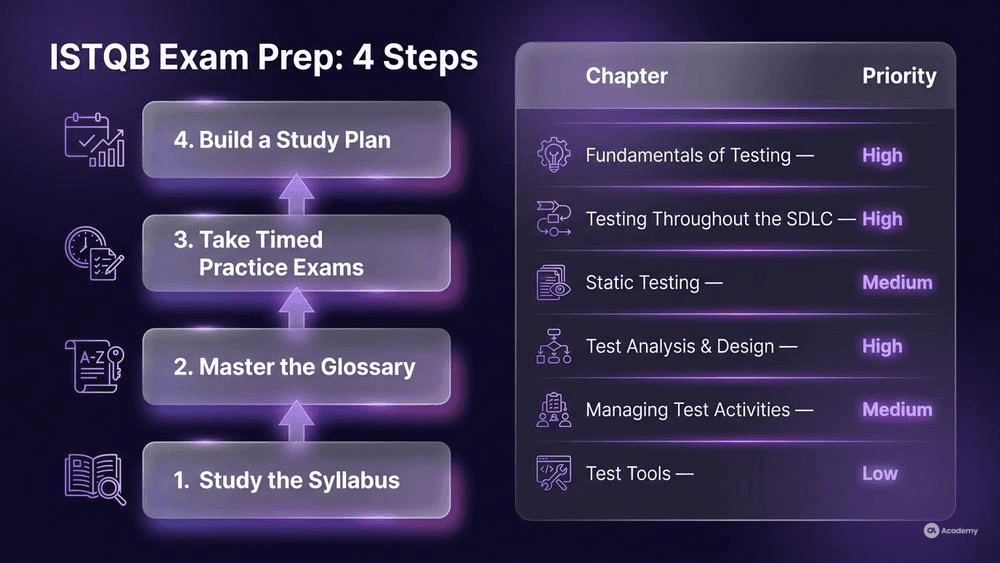
Step 1: Study the Syllabus, Not Just a Book
The vast majority of official exam questions are directly derived from the CTFL v4.0 syllabus [1]. Third-party books and courses can help you understand the material, but the syllabus is the primary source of truth. Download it from the official ISTQB website and treat it as your core study document.
Practical tip: Print the syllabus learning objectives. For each objective, write a one-sentence explanation in your own words. If you cannot, you have found a gap.
Step 2: Master the ISTQB Glossary
ISTQB exams test precise terminology. On the exam, the syllabus definition is treated as the authoritative correct answer — even when your workplace uses a term differently [2]. For example, ISTQB distinguishes between "error" (a human mistake), "defect" (a flaw in a work product), and "failure" (an incorrect outcome during execution). Confusing these terms costs points.
Step 3: Practice with Sample Exams Under Timed Conditions
Knowing the material and passing the exam are different skills. Practice exams train you to handle the time pressure and the specific phrasing of ISTQB questions. Allocate 90 seconds per question maximum — if you are stuck, mark it and move on.
Step 4: Build a Personalized Study Plan
Do not study every topic equally. Assess your current strengths and focus on gaps. Here is a lightweight template:
Syllabus Chapter | Self-Assessment (1-5) | Study Hours Needed | Priority |
|---|---|---|---|
Fundamentals of Testing | ? | ? | ? |
Testing Throughout the SDLC | ? | ? | ? |
Static Testing | ? | ? | ? |
Test Analysis and Design | ? | ? | ? |
Managing the Test Activities | ? | ? | ? |
Test Tools | ? | ? | ? |
Rate yourself honestly on each chapter, allocate hours proportionally, and schedule study sessions across 3-6 weeks.
Best Practices and Common Pitfalls
What to Do
- Study in short, focused sessions (45-60 minutes) rather than marathon cramming. Spaced repetition improves long-term retention.
- Form or join a study group. Explaining concepts to others exposes gaps in your understanding.
- Connect syllabus concepts to your real work. When you read about equivalence partitioning, immediately think about where you have used it (or should have used it) in your current project.
- Review the product quality model in ISO/IEC 25010 alongside ISTQB material — the syllabus references quality characteristics like functional suitability, reliability, and security that align directly with this standard [5].
- Plan your Advanced Level path early. If your career trajectory leans toward test automation engineering, the Technical Test Analyst module is more relevant than the Test Manager module. If you are moving toward test management or test strategy ownership, the Test Manager module is the better fit.
What NOT to Do (Via Negativa)
- Do not rely solely on brain dumps or memorized question banks. ISTQB regularly rotates exam questions. Memorizing answers without understanding the underlying concepts leads to failure when you encounter rephrased questions.
- Do not skip the syllabus and study only from third-party summaries. Summaries are useful supplements, but they sometimes simplify or misrepresent nuances — and the exam tests those nuances.
- Do not postpone the exam indefinitely. Certification knowledge has a half-life. If you study for six months without sitting the exam, you will need to re-study the first topics you covered.
- Do not treat certification as a finish line. The credential opens doors, but continuous learning — attending conferences, contributing to testing communities, experimenting with new tools — is what keeps you relevant.
- Do not assume certification alone will advance your career. Pair it with demonstrable skills: a GitHub portfolio of test automation projects, contributions to open-source testing tools, or measurable improvements you have driven in previous roles.
Tools and Resources Comparison
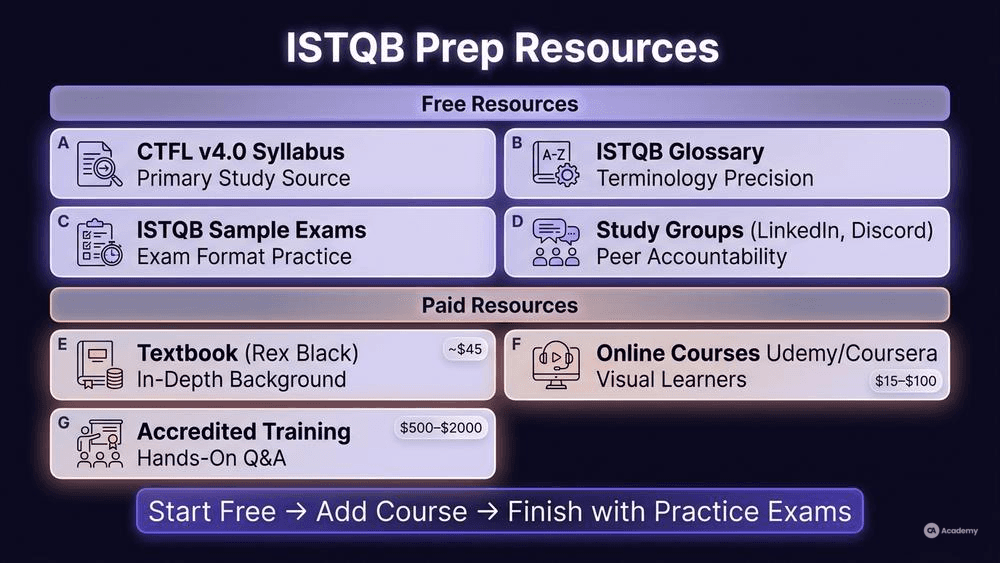
The following table summarizes exam preparation materials and resources available for ISTQB Foundation Level candidates. It is designed to help you choose the combination that fits your learning style and budget.
Resource | Type | Cost | Best For |
|---|---|---|---|
ISTQB CTFL v4.0 Syllabus [1] | Official document (PDF) | Free | Primary study source; required reading |
ISTQB Glossary [2] | Online reference | Free | Terminology precision; exam vocabulary |
ISTQB Sample Exams | Official practice questions | Free (via national boards) | Exam format familiarity |
"Foundations of Software Testing" (Rex Black et al.) | Textbook | ~$40-50 | In-depth explanations; background reading |
Udemy / Coursera ISTQB Courses | Video-based online courses | $15-100 | Visual learners; structured pacing |
Local Accredited Training Providers | Instructor-led classroom training | $500-2000 | Hands-on practice; direct Q&A |
Study Groups (LinkedIn, Discord) | Community-based peer learning | Free | Accountability; diverse perspectives |
Recommendation: Start with the free official syllabus and glossary. Add a third-party book or course only if you need additional explanation. Finish with timed practice exams.
Real-World Example
⚠️ Disclaimer: The following scenario is an illustrative example based on typical industry patterns. The specific metrics are hypothetical estimates designed to demonstrate realistic outcomes, not measured data from a documented project. They should not be cited as factual benchmarks.
Context
A mid-sized fintech company with 12 QA engineers across three Scrum teams noticed inconsistent testing practices. Each team used different terminology, different test case formats, and different criteria for evaluating test coverage. Defect reports lacked standardization, making cross-team metrics comparison unreliable. The test automation effort was fragmented — each team had built its own framework with different structure and naming conventions.
Challenge
The QA lead needed to unify testing practices without imposing a rigid, top-down process that would slow teams down. The core issues were:
- No shared vocabulary — "regression testing" meant different things to different teams.
- Test documentation formats varied, making audits time-consuming.
- New hires took 8-12 weeks to become productive because each team had its own unwritten conventions.
- Test automation scripts were not reusable across teams due to inconsistent design patterns.
Solution
The company sponsored ISTQB Foundation Level certification for all QA engineers and adopted the ISTQB Glossary as the team's standard terminology reference. They aligned their test documentation templates with the structure defined in ISO/IEC/IEEE 29119-3 [4]. Over six months, they also consolidated their test automation frameworks using shared design patterns, with naming conventions and structure aligned to the terminology from the ISTQB syllabus.
Results (Illustrative)
- Onboarding time dropped from approximately 10 weeks to approximately 4 weeks, as new hires could reference standardized documentation and terminology from day one.
- Cross-team defect report consistency improved by an estimated 70%, reducing the time spent clarifying ambiguous bug reports.
- Test automation script reuse increased by roughly 55%, since teams now followed a common design vocabulary and structure.
- Audit preparation time was reduced by approximately 60%, because documentation already followed a recognized standard format.
Key Takeaways
- Certification is most effective when combined with organizational process alignment — certifying individuals without changing team practices yields limited results.
- The shared language benefit of ISTQB is often more valuable than the credential itself.
- Connecting ISTQB vocabulary to test automation naming conventions improves framework maintainability across teams.